
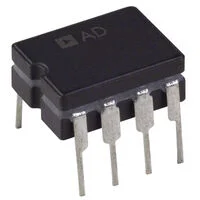
ADI AD620SQ/883B
- Single external resistor sets gain from 1 to 10,000 with 40 ppm maximum gain nonlinearity
- Low input offset voltage: 125 µV maximum with 1.0 µV/°C maximum drift over military temperature range
- Low power Superbeta input stage: 1.3 mA maximum supply current with 1.0 nA maximum input bias current
- 100 dB minimum CMRR at G=10 with 9 nV/√Hz input voltage noise at 1 kHz
- MIL-STD-883B qualified — 8-lead hermetic CERDIP package rated –55°C to +125°C
The ADI AD620SQ/883B is the military-qualified version of Analog Devices' AD620 instrumentation amplifier, processed to MIL-STD-883B and housed in an 8-lead hermetic CERDIP package rated for the full –55°C to +125°C military temperature range. It shares the same Superbeta input stage architecture and single-resistor gain-setting principle as the industrial AD620ANZ, but with hermetic ceramic packaging and 883B screening that makes it suitable for defense, aerospace, and high-reliability programs where plastic packaging and commercial screening are insufficient. A single external resistor between pins 1 and 8 sets gain from 1 to 10,000 — the same simplicity that has made the AD620 a default in-amp choice across precision signal chain designs for decades, now available with military qualification documentation.
The military temperature range imposes more demanding drift requirements than the industrial grade — the AD620SQ/883B specifies 125 µV maximum input offset voltage and 1.0 µV/°C maximum drift across –55°C to +125°C, compared to the tighter A and B grades available for industrial operation. For defense sensor interface designs where the in-amp operates across wide temperature swings in avionics bays, engine compartments, or shipboard environments, these specifications set the accuracy floor for the entire signal conditioning chain. The REF pin output offset capability, short-circuit protected output, and compatibility with the standard EVAL-INAMP-62RZ evaluation platform carry over from the commercial variants, making design-in straightforward for teams migrating from the industrial AD620ANZ to a qualified military component.

Related Products For Your Business
The AD620SQ/883B is the answer to a straightforward question in military in-amp procurement: which variant of the AD620 carries hermetic ceramic packaging and MIL-STD-883B screening? For defense programs that have standardized on the AD620 architecture — familiar gain-setting formula, known noise and drift behavior, validated layout — the SQ/883B designation provides the qualification documentation and hermetic CERDIP package that the military procurement specification requires, without moving to a different in-amp architecture or revalidating the signal conditioning design. The 8-lead CERDIP footprint is pin-compatible with the industrial AD620ANZ and AD620BNZ, so existing schematics and board layouts carry over directly.
AD620SQ/883B Architecture: Superbeta Input Stage in a Military Package
The Superbeta NPN input transistors that define the AD620’s input bias current performance — 1.0 nA maximum — are the same in the military and industrial variants. In the CERDIP package, this precision is now combined with the hermetic sealing and thermal stability that military deployments demand: no moisture ingress, no outgassing from plastic encapsulant, and consistent performance across the –55°C to +125°C military temperature range. The gain formula G = (49.4 kΩ / RG) + 1 applies identically to the SQ/883B, and the REF pin — which allows the output to be offset to any voltage within the output swing — carries over as well, enabling direct interface to single-supply ADCs in military data acquisition systems. For designs pairing the AD620SQ/883B with a precision voltage reference, the 5962-9078501MLA AD780S provides a 2.5V reference with 3 ppm/°C maximum drift in the same MIL-STD-883 qualification framework.
AD620SQ/883B vs AD620ANZ: Military vs Industrial Grade Selection
The core architecture is identical between the two variants. The selection is driven by package, qualification, and temperature range requirements:
| AD620SQ/883B | AD620ANZ | |
|---|---|---|
| Package | 8-Lead Hermetic CERDIP | 8-Lead Plastic DIP |
| Qualification | MIL-STD-883B | Commercial |
| Temperature Range | –55°C to +125°C | –40°C to +85°C |
| Offset Voltage (max) | 125 µV | 50 µV (A grade) |
| Offset Drift (max) | 1.0 µV/°C | 0.6 µV/°C (A grade) |
| Best For | Military / hermetic programs | Industrial / cost-sensitive designs |
The industrial AD620ANZ offers tighter offset specifications at the A grade — 50 µV versus 125 µV for the military variant. This is a consequence of the wider temperature range the SQ/883B must cover: maintaining a tighter offset specification across –55°C to +125°C requires binning that limits yield. For military programs where the hermetic package and 883B documentation are mandatory, the AD620SQ/883B is the correct procurement path regardless of the offset specification comparison.
Sourcing the ADI AD620SQ/883B
The AD620SQ/883B in its hermetic CERDIP package is an active-specification component in military instrumentation and avionics programs. We carry verified inventory with full lot traceability, MIL-STD-883B certificate of conformance, and anti-counterfeit inspection on every order. Contact us today to confirm availability and request a quote — our team responds within 24 hours.
- Pin-compatible with AD620ANZ and AD620BNZ — direct board-level migration from industrial to military grade
- Hermetic CERDIP package eliminates moisture ingress risk in military field deployment environments
- Single-resistor gain setting simplifies gain accuracy error budget versus discrete three op amp designs
- REF pin enables direct single-supply ADC interface without external level-shifting components
- Output short-circuit protected — fault-tolerant in military sensor interface environments
- Superbeta input stage holds bias current stable across the full military temperature range
- MIL-STD-883B certificate of conformance and full lot traceability on every order
- Export-compliant global shipping for defense and aerospace program procurement
Frequently Asked Questions (FAQ)
What Is the ADI AD620SQ/883B and How Does It Differ From the AD620ANZ?
The AD620SQ/883B is the military-qualified variant of the AD620 instrumentation amplifier, processed to MIL-STD-883B in an 8-lead hermetic CERDIP package, rated for –55°C to +125°C military operation. The AD620ANZ is the industrial A-grade variant in a plastic DIP package, rated for –40°C to +85°C. Both use the same single-resistor gain-setting architecture and are pin-compatible, but the SQ/883B provides hermetic packaging and military qualification documentation that the plastic DIP cannot offer.
Is the AD620SQ/883B Pin-Compatible With the Industrial AD620 Variants?
Yes. The 8-lead CERDIP package uses the same pinout as the AD620ANZ plastic DIP and AD620ARZ SOIC variants. Existing schematics and board layouts designed for the industrial AD620 are directly applicable to the AD620SQ/883B — no schematic or layout changes are required when migrating to the military-qualified variant.
What Is the Gain-Setting Formula for the AD620SQ/883B?
Gain is set by a single external resistor connected between pins 1 and 8 using the formula G = (49.4 kΩ / RG) + 1. For unity gain, the RG pins are left open. For G=10, RG = 5.49 kΩ; for G=100, RG = 499Ω; for G=1000, RG = 49.9Ω. Standard 1% resistor values cover the full 1 to 10,000 gain range without additional components.
Does the AD620SQ/883B Have an SMD Military Part Number?
The AD620SQ/883B is processed to MIL-STD-883B but does not carry a dedicated SMD 5962-series procurement designation. For programs requiring a formal SMD number for qualified sources list procurement, the AD620 family should be evaluated against available SMD-designated in-amp alternatives. For programs where 883B screening and hermetic packaging are sufficient without a formal SMD number, the AD620SQ/883B is a direct procurement path.
How Do I Request a Quote for the ADI AD620SQ/883B?
Submit an inquiry through our website contact form or email our sales team directly. We will respond within 24 hours with pricing, availability, and lead time — and can discuss long-term supply agreements for production programs.