
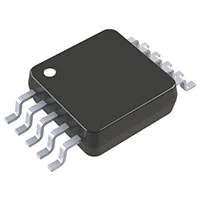
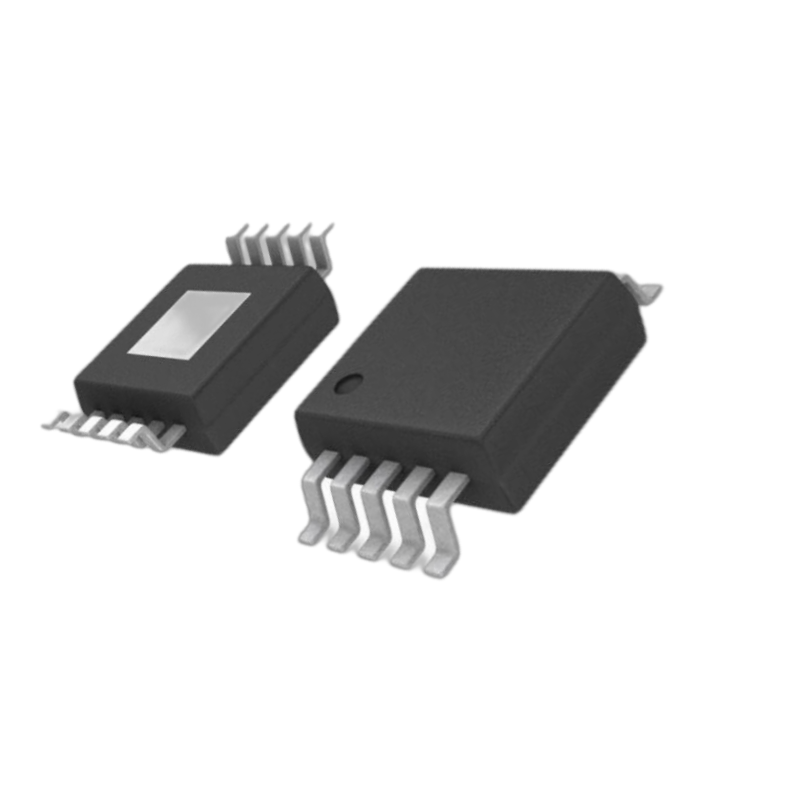
ADI AD7690BRMZ
- 18-bit PulSAR SAR ADC with 400 kSPS throughput and ±1.5 LSB maximum INL
- 102 dB dynamic range at 400 kSPS — 125 dB oversampled dynamic range at 1 kSPS
- True differential input with ±VREF range and external reference up to VDD
- SPI-compatible serial interface with daisy-chain capability and optional busy indicator
- Separate VIO supply for 1.8V to 5V logic compatibility — 10-lead MSOP package
The ADI AD7690BRMZ is the B-grade, tape-and-reel 10-lead MSOP variant of Analog Devices' AD7690 — an 18-bit, 400 kSPS PulSAR successive approximation ADC that achieves 102 dB dynamic range at full throughput and 125 dB oversampled dynamic range at 1 kSPS through noise-free code resolution of 20 bits. The PulSAR architecture delivers these specifications from a 2.5V to 5V supply with power consumption that scales linearly with throughput — at reduced conversion rates, power drops proportionally, making it well suited for power-sensitive precision measurement applications. The BRMZ suffix identifies the B-grade linearity specification (±1.5 LSB maximum INL), MSOP package, and tape-and-reel packaging for production builds.
What distinguishes the AD7690 from lower-resolution SAR ADCs is the combination of genuine 18-bit accuracy and the SPI interface features that make it practical in multi-channel and high-density system designs. The true differential input rejects common-mode noise with a range of ±VREF on both inputs, supporting direct connection to differential signal sources without a single-to-differential driver in many configurations. The separate VIO supply decouples the ADC's digital interface voltage from the analog supply, enabling direct connection to 1.8V, 2.5V, 3V, and 5V logic without level translation. The daisy-chain capability connects multiple AD7690 devices on a single three-wire SPI bus, with each device passing data through its SDI/SDO path — a significant reduction in FPGA or microcontroller pin count for multi-channel precision acquisition systems.

Related Products For Your Business
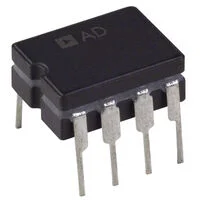
Eighteen-bit resolution is the specification that separates precision data acquisition systems from high-performance ones. At 102 dB dynamic range and ±1.5 LSB maximum INL, the ADI AD7690BRMZ operates at a level where the ADC itself is rarely the limiting factor in measurement accuracy — the noise floor, reference drift, and signal conditioning chain typically become the binding constraints before the converter does. The PulSAR architecture achieves this with power consumption that scales linearly with throughput, making the AD7690 practical across the full range from 1 kSPS oversampled applications to full 400 kSPS precision acquisition.
AD7690BRMZ Architecture: PulSAR Charge Redistribution at 18-Bit Accuracy
The PulSAR architecture uses a charge redistribution successive approximation technique with an internal capacitor array that is inherently low-noise and highly linear. No pipeline stages means no pipeline delay and no latency between the CNV rising edge and data availability — the conversion result is available immediately after the last SCK falling edge, which simplifies timing in real-time control and acquisition loops. The separate VIO pin is a practical design feature: with the digital interface referenced to VIO independently of the analog VDD supply, the AD7690BRMZ connects directly to FPGA I/O banks at 1.8V or 2.5V without level translators, while the analog section continues to operate at the higher VDD voltage that maximizes dynamic range. For designs requiring a precision external reference, the 5962-9078501MLA AD780S provides a 2.5V reference with 3 ppm/°C maximum drift — a natural companion for 18-bit precision acquisition designs where reference drift contributes meaningfully to the system accuracy budget.
AD7690BRMZ vs AD7690 Family: Grade and Package Selection
The AD7690 family offers two package options and two grade levels for production and prototype builds:
| AD7690BRMZ | AD7690BRMZ-RL7 | AD7690BCPZRL7 | |
|---|---|---|---|
| Package | 10-Lead MSOP | 10-Lead MSOP | 10-Lead LFCSP (QFN) |
| Grade | B (±1.5 LSB) | B (±1.5 LSB) | B (±1.5 LSB) |
| Packaging | Tape and Reel | 1500-unit mini reel | Tape and Reel |
| Footprint | Standard MSOP | Standard MSOP | Smaller QFN |
| Best For | Standard SMT production | Smaller production batches | Minimum board area |
The AD7690BRMZ is the standard production reel format in the MSOP package — the most widely stocked variant for volume production. For designs where minimum PCB footprint is the priority, the BCPZRL7 LFCSP (QFN) package provides a smaller outline with identical electrical specifications. For precision applications requiring tighter INL than ±1.5 LSB, the AD7691 (18-bit, 250 kSPS, ±0.75 LSB typical) offers improved typical linearity at reduced throughput.
Sourcing the ADI AD7690BRMZ
The AD7690BRMZ is an active-production standard product with broad distribution availability across precision instrumentation, industrial, and defense-adjacent programs. We carry verified inventory with full lot traceability and anti-counterfeit inspection on every order. Contact us today to confirm availability and request a quote — our team responds within 24 hours.
- No pipeline delay — conversion result immediately available after last SCK edge, simplifying real-time loop timing
- Power scales linearly with throughput — reduces dissipation at sub-400 kSPS conversion rates automatically
- Daisy-chain mode reduces multi-ADC SPI bus to three wires regardless of channel count
- Separate VIO supply eliminates level translators between ADC and 1.8V or 2.5V FPGA I/O banks
- Noise-free code resolution of 20 bits at 1 kSPS enables high-resolution measurements through oversampling
- Compatible with ADA4941-1 differential ADC driver for single-to-differential signal conditioning
- MSOP package enables compact board layout in multi-channel precision acquisition systems
- Full lot traceability and anti-counterfeit inspection on every order
Frequently Asked Questions (FAQ)
What Is the ADI AD7690BRMZ and What Makes It an 18-Bit ADC?
The AD7690BRMZ is the B-grade, 10-lead MSOP, tape-and-reel variant of the AD7690 — an 18-bit, 400 kSPS PulSAR SAR ADC with ±1.5 LSB maximum INL, 102 dB dynamic range, true differential input, and SPI serial interface with daisy-chain capability, rated for –40°C to +85°C industrial operation. The 18-bit resolution means the ADC quantizes its input range into 262,144 steps — a step size of approximately 38 µV for a 10V full-scale range.
How Does the Daisy-Chain Feature Work on the AD7690BRMZ?
In daisy-chain mode, the SDI pin of each AD7690 connects to the SDO of the previous device. After each conversion, the result shifts through the chain — all devices share a single SCK and CNV signal, with data appearing sequentially at the last device’s SDO pin. For N devices, 18N SCK cycles clock out all conversion results in sequence, reducing the SPI bus to three wires (CNV, SCK, SDO) regardless of how many ADCs are in the chain.
What External Reference Does the AD7690BRMZ Require?
The AD7690BRMZ requires an external reference voltage applied to the REF pin, ranging from 2.5V up to VDD. The full-scale differential input range equals ±VREF. A 5V reference gives ±5V input range; a 2.5V reference gives ±2.5V. For the lowest drift contribution to the 18-bit accuracy budget, a precision reference such as the 5962-9078501MLA AD780S provides 3 ppm/°C maximum drift — small relative to the AD7690’s 18-bit LSB size.
What Is the Difference Between AD7690BRMZ and AD7690BRMZ-RL7?
Both are electrically identical B-grade AD7690 devices in the 10-lead MSOP package. The BRMZ is a standard full reel (typically 2500 or 5000 units); the BRMZ-RL7 is a 1500-unit mini-reel suited for smaller production volumes. For prototype and low-volume builds, the cut-tape variant AD7690BRMSZ provides individual strips without reel minimums.
How Do I Request a Quote for the ADI AD7690BRMZ?
Submit an inquiry through our website contact form or email our sales team directly. We will respond within 24 hours with pricing, availability, and lead time — and can discuss volume pricing or long-term supply agreements if needed.