
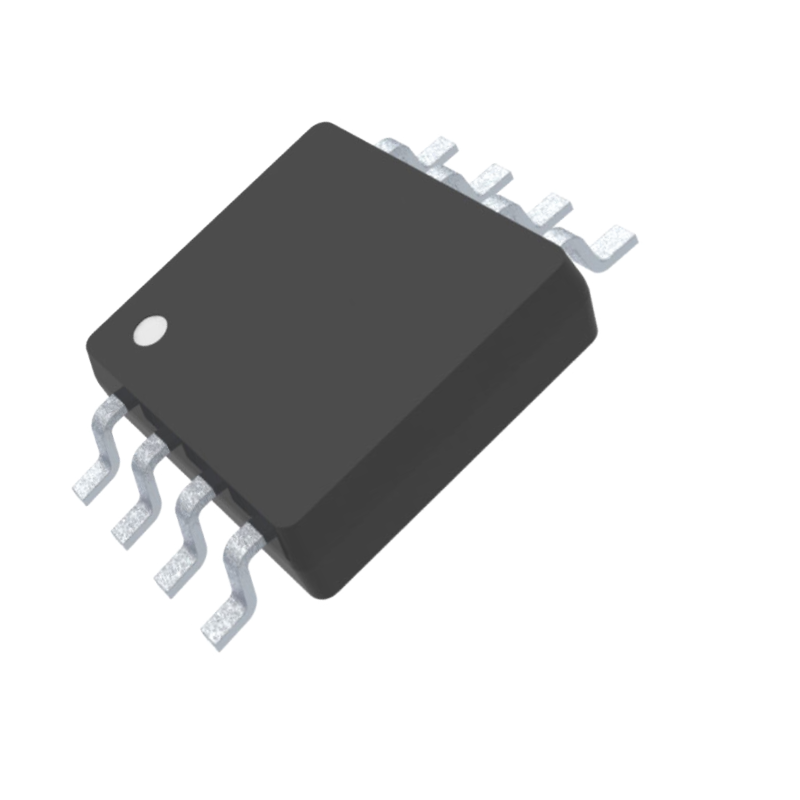
ADI AD8607ARMZ
- Dual micropower CMOS op amp with rail-to-rail input and output on 1.8V to 5V single supply
- 12 µV typical input offset voltage using patented trimming without laser trimming
- 0.5 pA maximum input bias current for femtoampere-level high-impedance sensor interfaces
- 400 kHz gain-bandwidth product with 27 µA quiescent current per amplifier for power-sensitive designs
- Extended temperature range from –40°C to +125°C in 8-lead MSOP package
The ADI AD8607ARMZ is the tape-and-reel 8-lead MSOP variant of the AD8607, a dual precision micropower CMOS rail-to-rail operational amplifier optimized for battery-powered, loop-powered, and power-sensitive aerospace and defense signal chain applications. Using a patented precision trimming technique that achieves 12 µV typical input offset voltage without laser trimming, the AD8607 delivers precision performance at 27 µA quiescent current per amplifier from supplies as low as 1.8V. The 0.5 pA maximum input bias current makes it suited to the high-impedance sensor interfaces common in defense instrumentation, where bias current-induced voltage errors at megaohm-range source impedances would otherwise dominate the offset budget.
Where the AD8606ARMZ prioritizes bandwidth and slew rate at 10 MHz GBW and 5 V/µs for active filtering and signal conditioning applications, the AD8607ARMZ targets power-constrained designs where the 400 kHz GBW is sufficient and the 27 µA per amplifier quiescent current enables operation from energy-harvesting sources, small batteries, or tightly budgeted power rails. Both share the same –40°C to +125°C extended temperature range and rail-to-rail input and output architecture. The ARMZ suffix identifies the 8-lead MSOP package in standard tape-and-reel format for surface-mount production builds in aerospace and defense programs.
Related Products For Your Business
Micropower precision in aerospace and defense signal chain design is not a contradiction — it is an increasingly common requirement. As defense systems migrate toward smaller SWaP (Size, Weight, and Power) envelopes, battery-operated field instruments, and energy-harvesting sensor nodes, the amplifier’s quiescent current becomes a system-level specification, not just a datasheet footnote. The ADI AD8607ARMZ delivers 12 µV typical input offset voltage and 0.5 pA maximum input bias current at 27 µA per amplifier from supplies as low as 1.8V, in a dual-channel 8-lead MSOP that fits the tightest defense electronics board layouts. For aerospace and defense programs where the signal chain must operate precisely at the lowest possible power, the AD8607ARMZ is the component that makes that tradeoff without sacrificing offset accuracy.
AD8607ARMZ Architecture: Patented Trimming and Micropower CMOS Precision
The precision trimming technique used in the AD8607 achieves 12 µV typical offset without laser trimming. The practical significance for defense signal chain designers is long-term offset stability: laser trimming can introduce residual stress in the silicon that relaxes over time and temperature cycles, degrading offset performance beyond the initial specification. The patented digital trimming approach avoids this mechanism, providing better long-term stability that is especially relevant in aerospace programs with multi-year deployment lifetimes and infrequent calibration access. The 0.5 pA maximum input bias current extends this precision to high-impedance source interfaces, where a 100 MΩ source impedance would produce only 50 µV of bias-induced error at maximum IB. The 100 dB PSRR is also significant for battery-powered defense applications where the supply voltage droops as the battery discharges, and the amplifier must maintain its offset and gain accuracy throughout the battery’s discharge curve.
AD8607ARMZ vs AD8606ARMZ: Micropower vs High-Performance Selection
The AD8607 and AD8606 are the two dual-channel precision CMOS op amps in the AD860x family, optimized for different performance priorities:
| AD8607ARMZ | AD8606ARMZ | |
|---|---|---|
| GBW | 400 kHz | 10 MHz |
| Slew Rate | 0.1 V/µs | 5 V/µs |
| Quiescent Current | 27 µA per amplifier | 1 mA per amplifier |
| Minimum Supply | 1.8V | 2.7V |
| Input Bias Current | 0.5 pA max | 1 pA max |
| Offset Voltage | 300 µV max | 80 µV max |
| Noise | 22 nV/√Hz | 8 nV/√Hz |
| Best For | Micropower, battery, loop-powered | Active filtering, wideband signal conditioning |
Choose the AD8607ARMZ when power consumption is the binding constraint and 400 kHz bandwidth is sufficient for the signal frequencies involved. Choose the AD8606ARMZ when bandwidth, slew rate, or lower offset voltage are the priority and the additional 1 mA per amplifier quiescent current is acceptable in the power budget.
Sourcing the ADI AD8607ARMZ
The AD8607ARMZ is an active-production standard product with broad distribution availability across aerospace, defense-adjacent, and industrial programs. We carry verified inventory with full lot traceability and anti-counterfeit inspection on every order. Contact us today to confirm availability and request a quote, and our team responds within 24 hours.
- 27 µA quiescent current per amplifier enables operation from energy-harvesting sources and small coin cells
- 1.8V minimum supply covers the full discharge curve of single-cell lithium batteries without dropout
- Patented trimming avoids laser-induced stress relaxation, supporting long-term offset stability in deployed systems
- 0.5 pA maximum bias current keeps bias-induced error negligible even at 100 MΩ source impedances
- 100 dB PSRR maintains accuracy as battery supply droops through discharge cycle
- AD8607ARMZ-REEL (3000 unit reel) available for volume production builds
- Pin-compatible with AD8607ARZ SOIC variant for layout migration between package sizes
- Full lot traceability and anti-counterfeit inspection on every order
Frequently Asked Questions (FAQ)
What Is the ADI AD8607ARMZ and How Does It Differ From the AD8606ARMZ?
The AD8607ARMZ is the micropower dual-channel variant of the AD860x family, with 27 µA quiescent current per amplifier, 400 kHz GBW, and 1.8V minimum supply. The AD8606ARMZ is the high-performance variant with 1 mA quiescent current, 10 MHz GBW, and 80 µV maximum offset voltage. Choose the AD8607 for power-constrained designs; choose the AD8606 for active filtering and wideband signal conditioning where higher bandwidth is required.
Why Is the Patented Trimming Technique Important for Long-Term Precision?
Laser trimming physically ablates resistors in the silicon to reduce offset, but the mechanical stress from this process can relax over time and temperature cycles, causing the offset to drift beyond its initial specification. The AD8607’s patented digital trimming technique makes no physical changes to the silicon, avoiding this stress mechanism and providing better long-term offset stability, which is particularly valuable in aerospace and defense programs with long deployment lifetimes.
What Is the Minimum Supply Voltage for the AD8607ARMZ?
The AD8607ARMZ operates from a 1.8V minimum single supply, or from dual supplies as low as ±0.9V. This covers the full usable discharge range of single-cell lithium-ion and lithium-polymer batteries, making it suitable for battery-powered defense field instruments without a regulated boost converter between the battery and the amplifier supply pin.
Is the AD8607ARMZ Suitable for Photodiode Transimpedance Amplifier Designs?
Yes. The 0.5 pA maximum input bias current and rail-to-rail input and output make the AD8607ARMZ well suited for photodiode TIA designs in defense optical sensor interfaces. The low bias current minimizes the DC offset error at high transimpedance values, and the micropower consumption is compatible with optical sensor assemblies where total power dissipation is a thermal management constraint.
How Do I Request a Quote for the ADI AD8607ARMZ?
Submit an inquiry through our website contact form or email our sales team directly. We will respond within 24 hours with pricing, availability, and lead time, and can discuss volume pricing or long-term supply agreements if needed.