
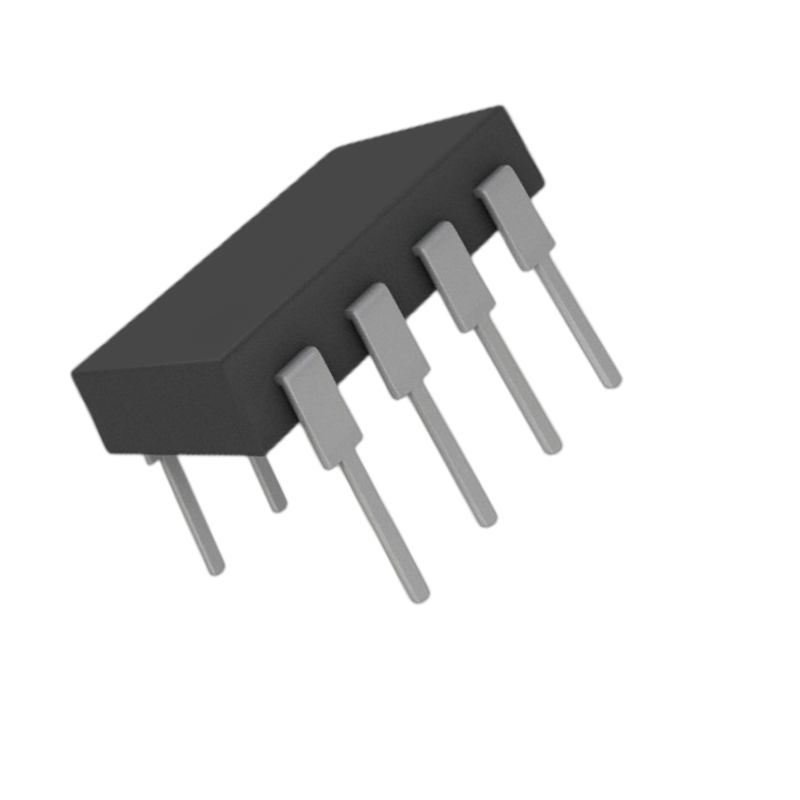
ADI 5962-8872101PA
- Dual ultra-low noise precision op amp — 5 nV/√Hz maximum voltage noise density at 1 kHz
- Excellent input offset voltage: 75 µV maximum with 1 µV/°C maximum drift
- Very high open-loop gain: 1,500 V/mV minimum for precise closed-loop accuracy
- Outstanding common-mode rejection: 106 dB minimum
- MIL-STD-883 Class B qualified — 8-lead ceramic DIP package
- Military temperature range: –55°C to +125°C
Noise is the ultimate constraint in precision military signal chains. Once it enters a signal, no amount of gain or filtering can recover what it has corrupted. The ADI 5962-8872101PA — the military SMD designation for Analog Devices' OP270Z processed to MIL-STD-883 Class B — addresses this at the amplifier level, with a 5 nV/√Hz maximum noise density that sets the floor for what the downstream signal chain has to work with. Two independent amplifier channels share a single 8-lead ceramic DIP package, making it a natural fit for differential signal processing, precision instrumentation, and two-channel analog front-end designs where board area and component count are constrained.
The OP270 architecture delivers the combination of low noise, low offset, and high gain that precision military applications demand — not just at room temperature, but across the full –55°C to +125°C range. The 75 µV maximum input offset voltage and 1 µV/°C maximum drift are specifications that hold across the military temperature range under MIL-STD-883 screening, not merely at 25°C. At 1,500 V/mV minimum open-loop gain and 106 dB minimum common-mode rejection, the OP270 maintains its precision even in electrically noisy military system environments where interference couples into signal paths. The 5 MHz gain-bandwidth product and 2.4 V/µs slew rate place it in the precision rather than high-speed category — the right trade for designs where noise floor matters more than bandwidth.

Related Products For Your Business
In precision military signal chain design, the op amp noise floor defines the system noise floor. Every nanovolt of amplifier noise referred to the input gets multiplied by the closed-loop gain — and in high-gain instrumentation amplifier configurations typical of military sensor interfaces, that multiplication is significant. The ADI 5962-8872101PA OP270Z sets a 5 nV/√Hz maximum ceiling on that contribution, processed to MIL-STD-883 Class B with full qualification documentation, in an industry-standard 8-lead ceramic DIP package that drops into existing dual op amp footprints without layout changes.
5962-8872101PA Architecture: Why 5 nV/√Hz Matters in Military Designs
The OP270’s 5 nV/√Hz maximum specification at 1 kHz is meaningful precisely because it is a maximum, not a typical — guaranteed under MIL-STD-883 screening across the military temperature range. Combined with the 75 µV maximum input offset voltage and 1 µV/°C drift ceiling, it delivers predictable noise and offset performance at temperature extremes where commercial-grade amplifiers often exceed their stated specifications. The 1,500 V/mV minimum open-loop gain ensures that closed-loop gain errors remain small even in high-gain configurations, while the 106 dB minimum CMR actively suppresses the common-mode interference that couples into sensor cables and long signal runs in military system installations.
5962-8872101PA in Military Precision Signal Chains
The OP270Z is frequently used at the input stage of precision signal chains — ahead of ADCs — where its noise performance sets the achievable signal-to-noise ratio for the entire downstream system. In designs using the 5962-9451801MLA AD7572S 12-bit ADC, a low-noise front-end amplifier like the 5962-8872101PA prevents the ADC’s full dynamic range from being noise-limited by the amplifier stage. For DAC output stages using the 5962-8770002EA AD7226 quad DAC, the OP270’s high open-loop gain and low offset voltage support precise voltage output conditioning. The industry-standard 8-lead dual pinout also makes it a straightforward upgrade path from lower-performance dual op amps on existing military boards.
Sourcing the ADI 5962-8872101PA
The OP270Z in its military ceramic DIP package has been a staple of defense electronics for decades, and the 5962-8872101PA remains actively specified in both legacy maintenance programs and new designs where its noise and precision combination is difficult to match in a qualified component. We maintain verified inventory with full lot traceability, MIL-STD-883 certificate of conformance, and anti-counterfeit inspection on every order. Contact us today to confirm availability and request a quote — our team responds within 24 hours.
- 5 nV/√Hz maximum noise density — a guaranteed ceiling, not a typical, across the military temperature range
- Dual channel in one package — reduces component count in two-channel signal chain designs
- Industry-standard 8-lead dual op amp pinout — direct footprint replacement for lower-performance alternatives
- 106 dB minimum CMR actively suppresses interference in military sensor cable environments
- 1,500 V/mV minimum open-loop gain maintains closed-loop accuracy in high-gain configurations
- ±2V to ±18V supply range accommodates both low-voltage and standard military supply rails
- MIL-STD-883 Class B qualification with full lot traceability documentation
- 8-lead ceramic DIP package — hermetic construction for military environmental reliability
Frequently Asked Questions (FAQ)
What Is the ADI 5962-8872101PA and What Is Its Commercial Equivalent?
The 5962-8872101PA is the military SMD procurement designation for Analog Devices’ OP270Z, processed to MIL-STD-883 Class B under drawing 5962-88721. It is a dual ultra-low noise precision operational amplifier with 5 nV/√Hz maximum voltage noise density, 75 µV maximum input offset voltage, and 106 dB minimum CMR, rated for military operation from –55°C to +125°C in an 8-lead ceramic DIP package.
How Does the 5962-8872101PA Compare to the OP27 in Military Applications?
The OP270 is Analog Devices’ dual version of the OP27, sharing comparable noise and precision performance in a dual package. Where the OP27 provides a single amplifier channel in an 8-lead package, the OP270 provides two independent channels in the same footprint — making the 5962-8872101PA the natural choice when two precision low-noise amplifier channels are needed and board area or component count is constrained.
What Is the Noise Density Specification and Why Does It Matter?
The 5 nV/√Hz voltage noise density specifies how much noise the amplifier contributes per unit bandwidth, referred to its input. In a system with 40 dB of gain, this noise gets multiplied by 100 at the output. Lower noise density directly improves the system signal-to-noise ratio, which determines the minimum detectable signal level — a critical parameter in radar receivers, inertial sensors, and precision instrumentation applications.
Is the 5962-8872101PA Pin-Compatible With Other Dual Op Amps?
Yes. The OP270Z uses the industry-standard 8-lead dual op amp pinout, which is shared by a wide range of dual precision amplifiers. This makes the 5962-8872101PA a drop-in replacement for lower-performance dual op amps in existing military board designs without PCB layout changes.
How Do I Request a Quote for the ADI 5962-8872101PA?
Submit an inquiry through our website contact form or email our sales team directly. We will respond within 24 hours with pricing, availability, and lead time — and can discuss long-term supply agreements for production programs.